
Our products aims to
simplify & clarify
the complex trade dynamics that
affect a business’s risk
Publications

NEWS

The Steel Sector’s Contribution to the Economy

Safeguard protection is granted whenever an industry is suffering from serious financial injury, caused by an increase in imports, which was because of unforeseen developments stemming out of the 1994 GATT negotiations, to which South Africa was a signatory.

Safeguard measures are enacted to ensure enough breathing room for the domestic manufacturing industry in distress to adjust and become more competitive, usually within a period of 3-6 years.

For this remedial protection to be effective, these safeguard duties need to be monitored and enforced across the board. However, as part of the Safeguard Agreement, the Safeguard Regulations creates an “Exempted Countries” list. This exemption has shown to provide a safeguard duty-free roue for imports from countries which are developing in nature and from where imports did not originate prior to the imposition of the safeguard duties.

The” circumvention” becomes a problem when the bigger importers switch their sources from imports from the traditional exporting countries like China and Russia, to smaller, developing nations, like Taiwan and Indonesia, effectively bypassing the Safeguard duties in their entirety.
Other WTO member countries would normally act quickly against these changes by removing these “developing nations” quickly once its import volume exceeds the established threshold. No further investigation is required.

In South Africa, the remedial action linked to the imposition of safeguard measures are failing because the officer in charge of this administrative action, the Minister of Trade, Industry and Competition, Minister Dave Patel, fails in his duty to authorise these exempted country removals immediately, or at all in some cases. Imports that reduced because of the imposition of the safeguard duties, with a resultant uptick in local production, regained lost ground within a year of the duties being imposed, rendering the safeguard protection completely impotent.

Below is an import chart, providing insight on how imports of Hexagon Nuts, a product protected by safeguard duties have climbed to almost pre-safeguard levels, because of a lack of action by the government to curb imports from developing nations.
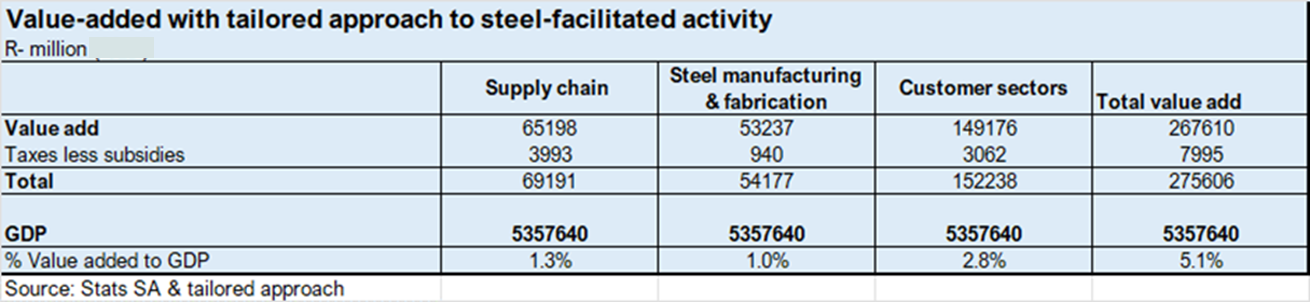

The steel industry remains a major contributor to the South African economy and its value add to the country’s GDP is more than 5%. In 2020 South Africa ranked 35th in the world as a crude steel producer and is currently the third largest producer in Africa.

Total South African crude steel production capacity is about 8.5 million tonnes per year, but the effective rate is closer to 6.5 million tonnes. The anchor producer is ArcelorMittal South Africa, the local unit of global steelmaker ArcelorMittal Group based in Luxembourg, which is majority owned by Indian steel tycoon Lakshmi Mittal.

After years of heavy losses punctuated by short-term gains, the primary steel industry posted in 2021 its strongest recovery since 2008 which was underpinned by the results published by ArcelorMittal South Africa for the financial year ending 31 December 2021.

South African Crude Steel Production vs Capacity Utilisation for Basic Iron and Steel Products­

Utilisation rates give a better indication of directionality in the local steel industry as there is no consensus on “capacity". In high demand times, furnaces have been run harder; in low demand times, worker shifts have been dropped or equipment “hot idled.”

Utilisation targets are used by some countries to set thresholds for trade interventions such as tariffs. (e.g., EU, US, South Korea and Japan)

South African Exposure to Steel Markets

The magnitude of the Apparent Steel Consumption (ASC) in construction which includes all intermediary products such as pipe and tube, wire, fasteners, etc., is an indication of the level of value-add through the steel value chain. It is also the reason South Africa’s ASC is so dependent on infrastructure spend.

- by Charles Dednam
footer logo
We study the markets, trends, and emerging best practices, in various steel related industries and cover Trade Development and Operational Excellence to unlock the present and future value for our customers.
Give us a Call
Copyright © 2025. All Rights Reserved. Commodity Trade Observer. Designed and Developed by ThinkTank Creative. Privacy Policy.