Safeguard protection is granted whenever an industry is suffering from serious financial injury, caused by an increase in imports, which was because of unforeseen developments stemming out of the 1994 GATT negotiations, to which South Africa was a signatory.
Safeguard measures are enacted to ensure enough breathing room for the domestic manufacturing industry in distress to adjust and become more competitive, usually within a period of 3-6 years.
For this remedial protection to be effective, these safeguard duties need to be monitored and enforced across the board. However, as part of the Safeguard Agreement, the Safeguard Regulations creates an “Exempted Countries” list. This exemption has shown to provide a safeguard duty-free roue for imports from countries which are developing in nature and from where imports did not originate prior to the imposition of the safeguard duties.
The” circumvention” becomes a problem when the bigger importers switch their sources from imports from the traditional exporting countries like China and Russia, to smaller, developing nations, like Taiwan and Indonesia, effectively bypassing the Safeguard duties in their entirety.
Other WTO member countries would normally act quickly against these changes by removing these “developing nations” quickly once its import volume exceeds the established threshold. No further investigation is required.
In South Africa, the remedial action linked to the imposition of safeguard measures are failing because the officer in charge of this administrative action, the Minister of Trade, Industry and Competition, Minister Dave Patel, fails in his duty to authorise these exempted country removals immediately, or at all in some cases. Imports that reduced because of the imposition of the safeguard duties, with a resultant uptick in local production, regained lost ground within a year of the duties being imposed, rendering the safeguard protection completely impotent.
Below is an import chart, providing insight on how imports of Hexagon Nuts, a product protected by safeguard duties have climbed to almost pre-safeguard levels, because of a lack of action by the government to curb imports from developing nations.
South Africa’s steel industry is standing at a critical juncture. With Asian imports dominating the market and Donald Trump’s return to the U.S. presidency reigniting global trade tensions, the urgency for a bold and strategic policy response has never been greater.
For too long, the country has allowed unchecked steel imports to erode its industrial base, threatening jobs, investment, and South Africa’s role as a key supplier to the African continent. If we fail to act now, we risk losing not just a sector—but an entire ecosystem of industrial capabilities.
The unchecked influx of low-cost steel imports is eroding South Africa’s steel manufacturing base, threatening jobs, investment, and industrial capacity. Key concerns include:
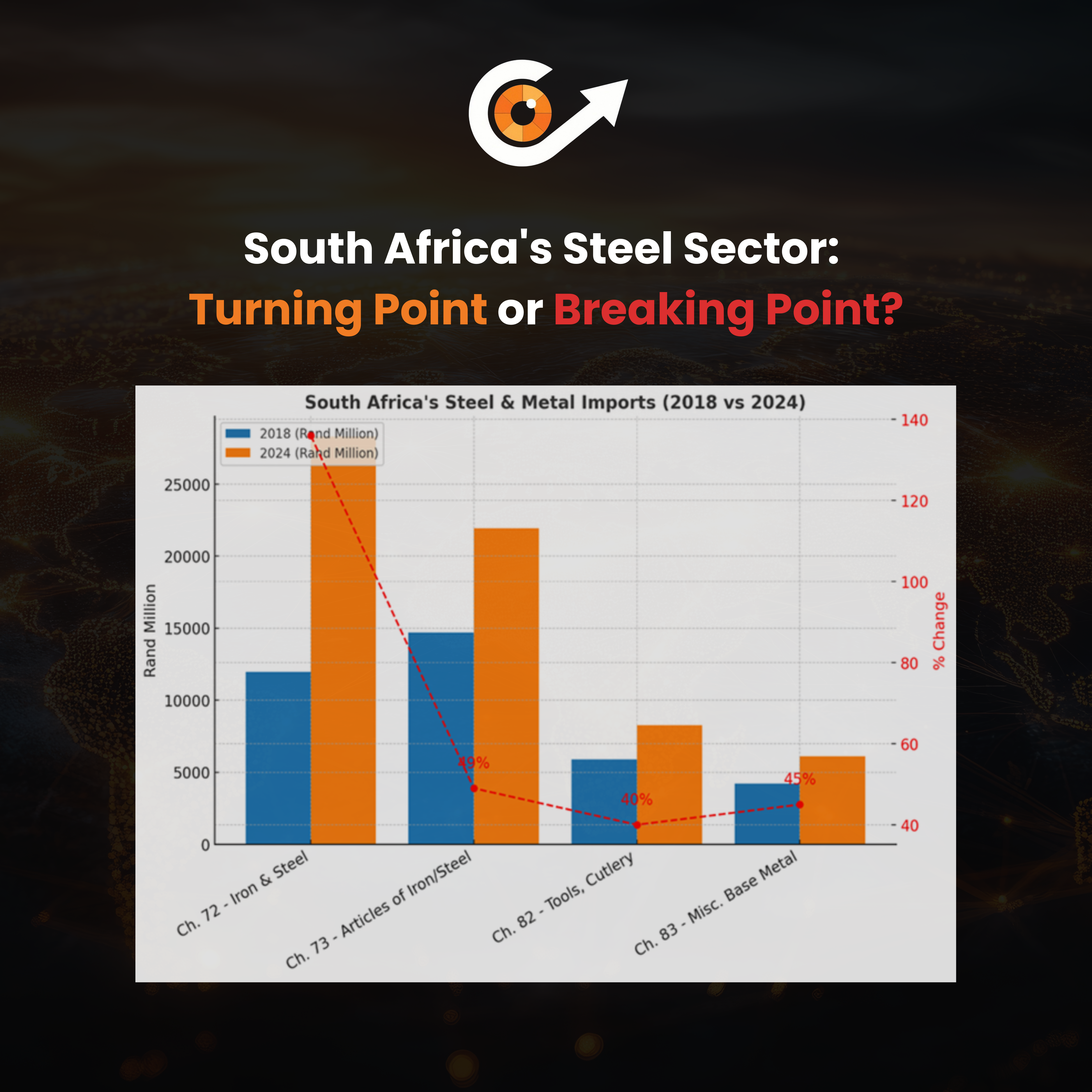
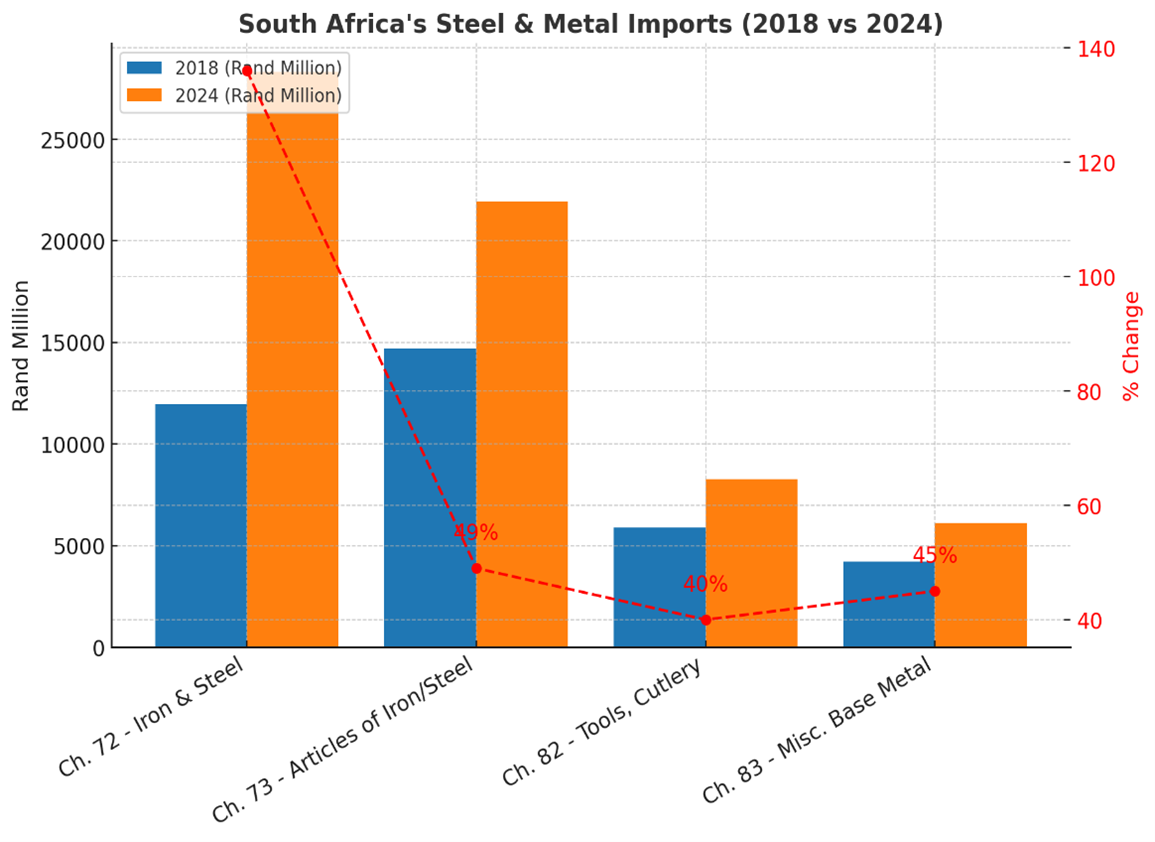
• Displacement of Local Production: A 136% surge in total steel imports (Chapter 72, excluding 7201-7204) between 2018 and 2024 highlights the growing replacement of domestic products with foreign alternatives.
• Africa’s Market at Risk: With the U.S. restricting steel imports, major Asian producers could aggressively target African markets, displacing South Africa’s exports in critical regional trade corridors.
• Erosion of Competitiveness: Weak trade protections and rising energy costs make it increasingly difficult for local producers to compete, further jeopardising industrial sustainability.
The latest trade data shows a clear trend: Asia is the dominant source of steel imports, with its share growing rapidly and uncontrollably.
Key observations:
• Iron and steel imports from Asia have surged to from R6.6 billion in 2018 to a staggering R18.4 billion in 2024—demonstrating significant market penetration.
• Imports of steel articles (finished products) from Asia have skyrocketed by 48%, making it near impossible for South African fabricators to compete.
• Africa remains a critical export market for South Africa, but the shift in global trade dynamics has seen Asian products capturing a larger share of this market, reducing demand for locally produced steel. Furthermore, emerging players in the continent that is backed by China’s investment such as DISCO in Zimbabwe adds another layer of competitive complexity.
The long-awaited review of South Africa’s steel tariff structure by the International Trade Administration Commission (ITAC) is vital for the sector’s future. However, despite promises from ITAC Chief Commissioner Ayabonga Cawe, the review has yet to even commence, leaving the industry in uncertainty. The stakes are high, with rising imports and recent closures, such as ArcelorMittal South Africa’s (South Africa’s largest steel producer) long products division, threatening thousands of jobs and the sector’s viability.
The tariff review, which covers steel products valued at R66 billion, could provide much-needed protection or tariff adjustments for local manufacturers. However, delays in starting the review risk exacerbating existing challenges. Policy changes, like the price preference system for scrap metal, have already negatively affected traditional producers, and without swift action, the entire supply chain could collapse.
ITAC must expedite the review process to provide the steel industry with clarity and stability. While public consultations are important, the timeline must be shortened to prevent further destabilisation. Industry stakeholders must engage proactively to ensure that the review’s outcomes support the sector’s long-term sustainability.
• South Africa’s steel industry is at risk as Asian imports continue to surge, now accounting for the majority of steel entering and being sold in the country.
• Trump’s trade policies are expected to worsen the situation, redirecting excess global supply to South Africa and the African continent.
• A proactive trade policy review is crucial to prevent further erosion of local steel production and to maintain South Africa’s industrial strength and capabilities.
Without urgent intervention, South Africa will lose its position as a key steel supplier to Africa—an outcome that would have serious economic and employment consequences.
The moment to protect our industry is now.