Safeguard protection is granted whenever an industry is suffering from serious financial injury, caused by an increase in imports, which was because of unforeseen developments stemming out of the 1994 GATT negotiations, to which South Africa was a signatory.
Safeguard measures are enacted to ensure enough breathing room for the domestic manufacturing industry in distress to adjust and become more competitive, usually within a period of 3-6 years.
For this remedial protection to be effective, these safeguard duties need to be monitored and enforced across the board. However, as part of the Safeguard Agreement, the Safeguard Regulations creates an “Exempted Countries” list. This exemption has shown to provide a safeguard duty-free roue for imports from countries which are developing in nature and from where imports did not originate prior to the imposition of the safeguard duties.
The” circumvention” becomes a problem when the bigger importers switch their sources from imports from the traditional exporting countries like China and Russia, to smaller, developing nations, like Taiwan and Indonesia, effectively bypassing the Safeguard duties in their entirety.
Other WTO member countries would normally act quickly against these changes by removing these “developing nations” quickly once its import volume exceeds the established threshold. No further investigation is required.
In South Africa, the remedial action linked to the imposition of safeguard measures are failing because the officer in charge of this administrative action, the Minister of Trade, Industry and Competition, Minister Dave Patel, fails in his duty to authorise these exempted country removals immediately, or at all in some cases. Imports that reduced because of the imposition of the safeguard duties, with a resultant uptick in local production, regained lost ground within a year of the duties being imposed, rendering the safeguard protection completely impotent.
Below is an import chart, providing insight on how imports of Hexagon Nuts, a product protected by safeguard duties have climbed to almost pre-safeguard levels, because of a lack of action by the government to curb imports from developing nations.
The post-ITAC phase for imposing trade remedies (especially anti-dumping and safeguard duties) is a known bottleneck. ITAC conducts the investigation under the International Trade Administration Act and Anti-Dumping Regulations. It issues a final recommendation to the Minister of Trade, Industry and Competition. If approved, the Minister requests the Minister of Finance under section 56 of the Customs and Excise Act to amend Schedule 2 via Government Gazette notice.
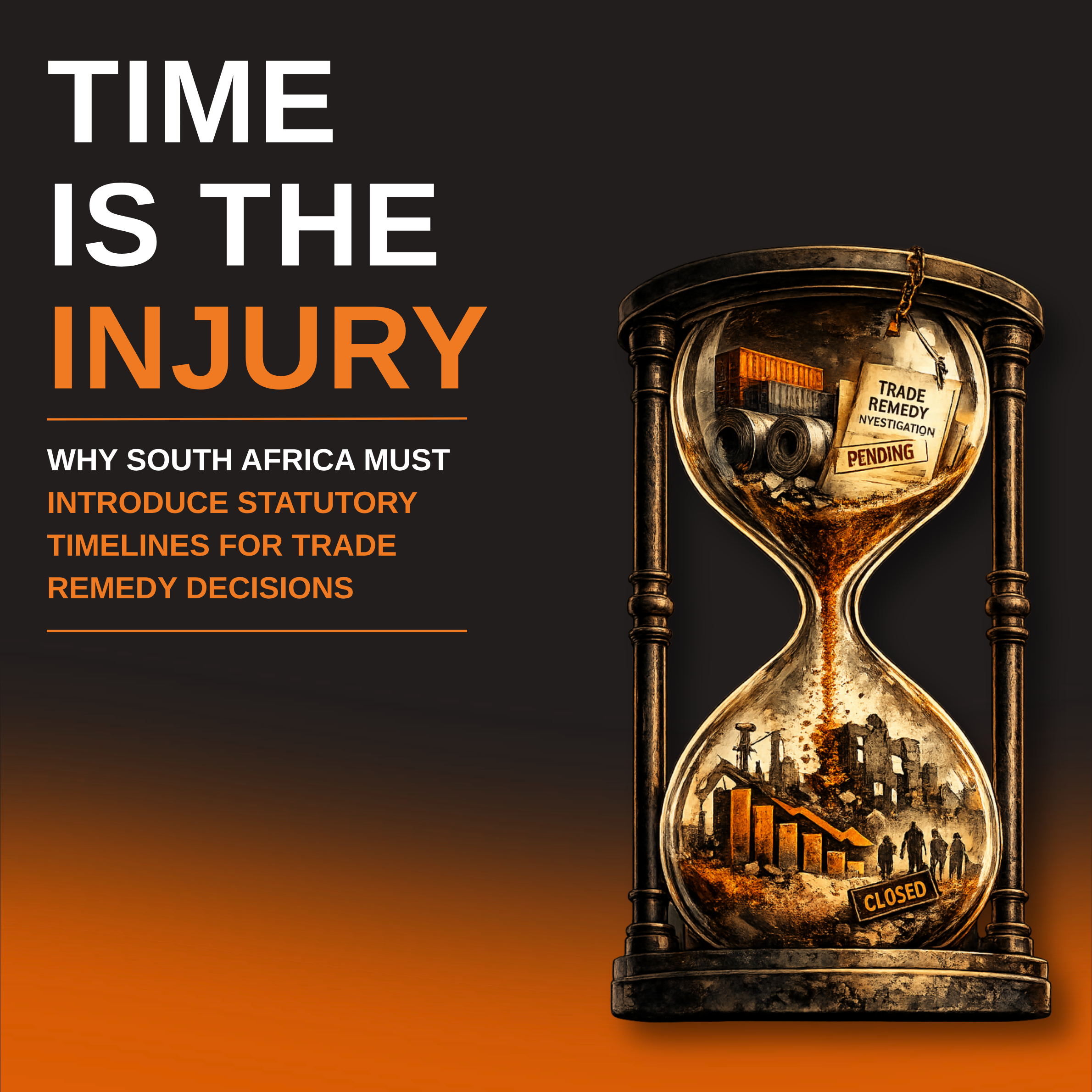
There are no statutory timelines for the Ministers’ consideration, approval, request, or Gazette publication. Delays result from detailed scrutiny for legal defensibility (PAJA compliance, rationality, judicial review risk), policy alignment, and coordination between departments. This extends the overall process and weakens timely protection, particularly safeguard investigations, supposed to be emergency measures and for anti-dumping cases.
• Submit strong, complete applications with precise evidence of dumping, injury, and causality, and cooperate fully during the investigation. Well-documented cases reduce the need for extra scrutiny after the recommendation.
• After a positive final recommendation, immediately send urgent written representations to the Minister of Trade (copy the Minister of Finance and ITAC) highlighting ongoing injury, economic impact, any expiring provisional duties, and the public interest in quick action.
• If no decision after 15 –30 days, formally demand written reasons and a decision timeline under PAJA. Follow up with a letter of demand threatening a court application to compel a timely decision. Industry associations can coordinate or lead this pressure.
• Engage collectively through sector bodies to raise the issue with the dtic parliamentary portfolio committee and push for the legislative timelines in submissions on the current amendment proposals.
Industry should collectively advocate for a clear “Trade Remedies Timelines Amendment” (or inclusion in the current reform process) that caps the full process and introduces automatic triggers or deemed approvals. This directly addresses the post-investigation drift that undermines the effectiveness of remedies. Without structural change, even strong ITAC outcomes remain vulnerable to prolonged delay.
• Section 1(3) of the Act reinforces the contradiction The Act must be interpreted in a manner that gives effect to the object in Section 2. A decision-making process with no time limits or deemed-approval mechanisms fails to give effect to the object of efficiency and effectiveness.