Our products aims to
simplify & clarify
the complex trade dynamics that
affect a business’s risk
Publications

NEWS

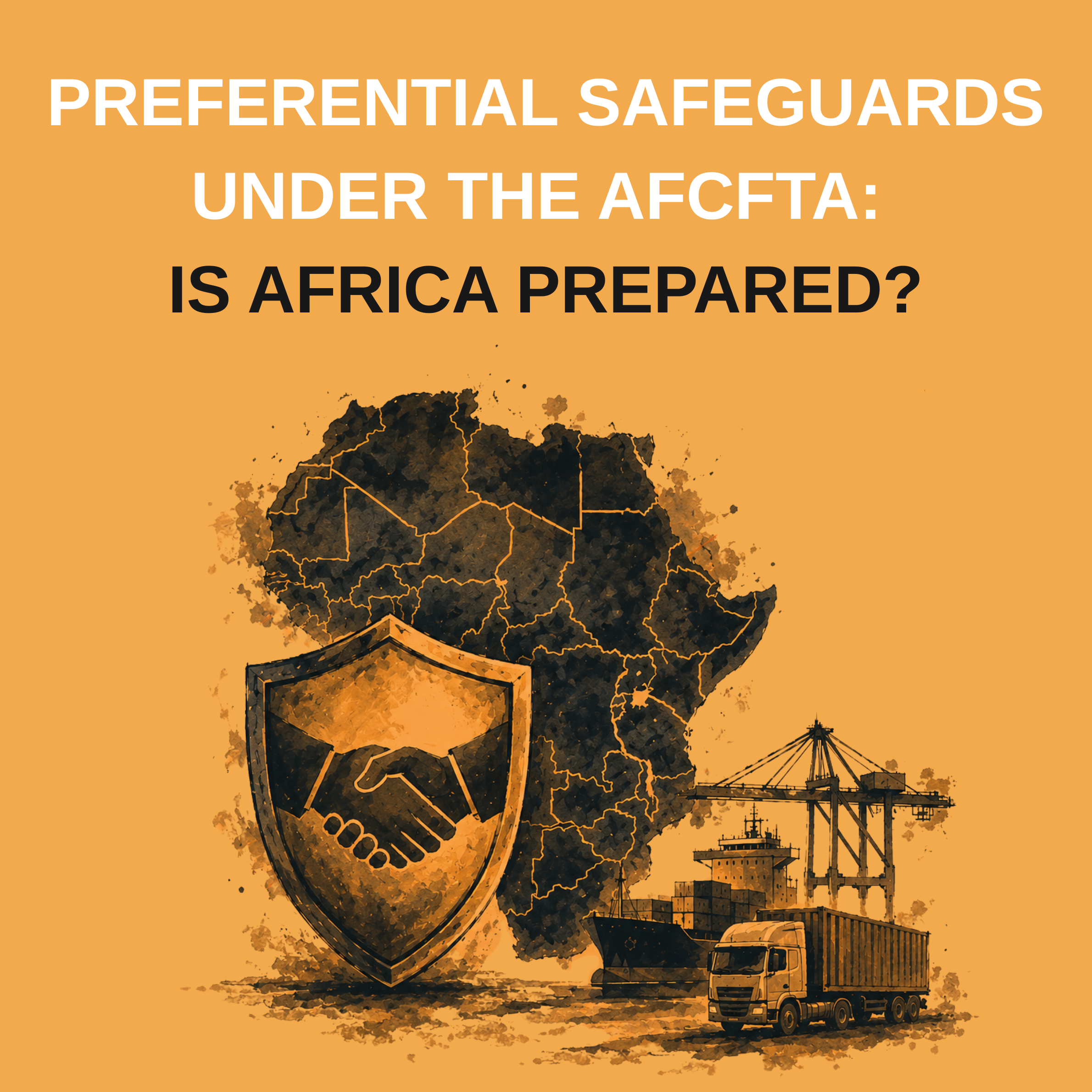
PREFERENTIAL SAFEGUARDS UNDER THE AFCFTA: IS AFRICA PREPARED?

Safeguard protection is granted whenever an industry is suffering from serious financial injury, caused by an increase in imports, which was because of unforeseen developments stemming out of the 1994 GATT negotiations, to which South Africa was a signatory.

Safeguard measures are enacted to ensure enough breathing room for the domestic manufacturing industry in distress to adjust and become more competitive, usually within a period of 3-6 years.

For this remedial protection to be effective, these safeguard duties need to be monitored and enforced across the board. However, as part of the Safeguard Agreement, the Safeguard Regulations creates an “Exempted Countries” list. This exemption has shown to provide a safeguard duty-free roue for imports from countries which are developing in nature and from where imports did not originate prior to the imposition of the safeguard duties.

The” circumvention” becomes a problem when the bigger importers switch their sources from imports from the traditional exporting countries like China and Russia, to smaller, developing nations, like Taiwan and Indonesia, effectively bypassing the Safeguard duties in their entirety.
Other WTO member countries would normally act quickly against these changes by removing these “developing nations” quickly once its import volume exceeds the established threshold. No further investigation is required.

In South Africa, the remedial action linked to the imposition of safeguard measures are failing because the officer in charge of this administrative action, the Minister of Trade, Industry and Competition, Minister Dave Patel, fails in his duty to authorise these exempted country removals immediately, or at all in some cases. Imports that reduced because of the imposition of the safeguard duties, with a resultant uptick in local production, regained lost ground within a year of the duties being imposed, rendering the safeguard protection completely impotent.

Below is an import chart, providing insight on how imports of Hexagon Nuts, a product protected by safeguard duties have climbed to almost pre-safeguard levels, because of a lack of action by the government to curb imports from developing nations.

The African Free Continental Trade Area (AfCFTA) is the world’s largest free trade area (FTA), it is projected to expand Africa’s economy to US$29 trillion by 2050. The AfCFTA Agreement mandates member states to progressively eliminate tariffs and non-tariff barriers to trade in goods. Consequently, member states agreed to liberalise 90% of tariffs. So far, 48 State Parties have adopted Provisional Schedules of Tariff Concessions, while 24 countries have gazetted their tariff schedules and begun trading under the AfCFTA.

Undoubtedly, notable progress has been made in the implementation of the AfCFTA. However, trade liberalisation is like a double-edged sword with both advantages and disadvantages. When countries lower their tariffs and remove other barriers to trade, local markets are increasingly vulnerable to price volatility. These markets are exposed to the effects of foreign competition which triggers import surges. Transitional phases constitute a fragile and critical period for any FTA. One of the main tools in navigating this transition and successfully implementing the AfCFTA is the Preferential Safeguard.

WTO global safeguards address the application of safeguard measures on a multilateral level, while regional safeguards apply to trade distortions as a result of implementing regional trade agreements. They are also referred to as ‘transitional measures’ because they may not be invoked after the termination of the transition period.

Trade Remedies are generally covered under Articles 16, 17,18 and 19 of the AfCFTA Agreement, Annexure 9 and the Guidelines on Implementation of Trade Remedies. Preferential safeguards are provided for under Article 4 of Annexure 9. The application of Preferential Safeguard Measures is prompted by the implementation of the AfCFTA, where the following conditions are met:

Trigger: Surge in imports (absolute or relative to domestic production) from other AfCFTA countries due to tariff preferences.
Threshold: Must cause or threaten serious Injury to local producers.
Scope of product: Applies only to like or directly competitive products.
Legality: The measures must follow the rules and procedures set out in Annex 9 and the AfCFTA Guidelines.

Other key conditions for application of a preferential safeguard include that it shall be applied only to the extent necessary to prevent or remedy serious injury or threat thereof and to facilitate adjustment following an investigation by the importing State Party. Furthermore, preferential safeguards may be applied for an initial period of 4 years. This period may be extended to another period not exceeding 4 years, subject to justification by the investigating authority. Most importantly, Annexure 9 prohibits the simultaneous application of a global safeguard measure alongside a preferential safeguard measure on the same product within the AfCFTA.

While preferential safeguard measures are built into the agreement as safety valves for the transition period, challenges persist. Only a handful of African countries regularly conduct trade remedy investigations. This has been attributed to the predominant use of tariff measures, technical, financial, and legal capacity constraints. As such, there is an urgent need to strengthen the capacity of domestic investigating authorities for an effective and functional trade remedies regime under the AfCFTA. Additionally, intra-African trade volumes remain significantly low, accounting for a only 14.4% of the region’s formal trade. This presents a huge challenge for trade remedy investigations, particularly the preferential safeguards which are volume-based.

In conclusion, the preferential safeguards are a major tool in successfully transitioning the AfCFTA towards operationalisation. In the interim, hurdles remain to be overcome.

- Grace Jelimo

footer logo
We study the markets, trends, and emerging best practices, in various steel related industries and cover Trade Development and Operational Excellence to unlock the present and future value for our customers.
Give us a Call
Copyright © 2025. All Rights Reserved. Commodity Trade Observer. Designed and Developed by ThinkTank Creative. Privacy Policy.