Our products aims to
simplify & clarify
the complex trade dynamics that
affect a business’s risk
Publications

NEWS

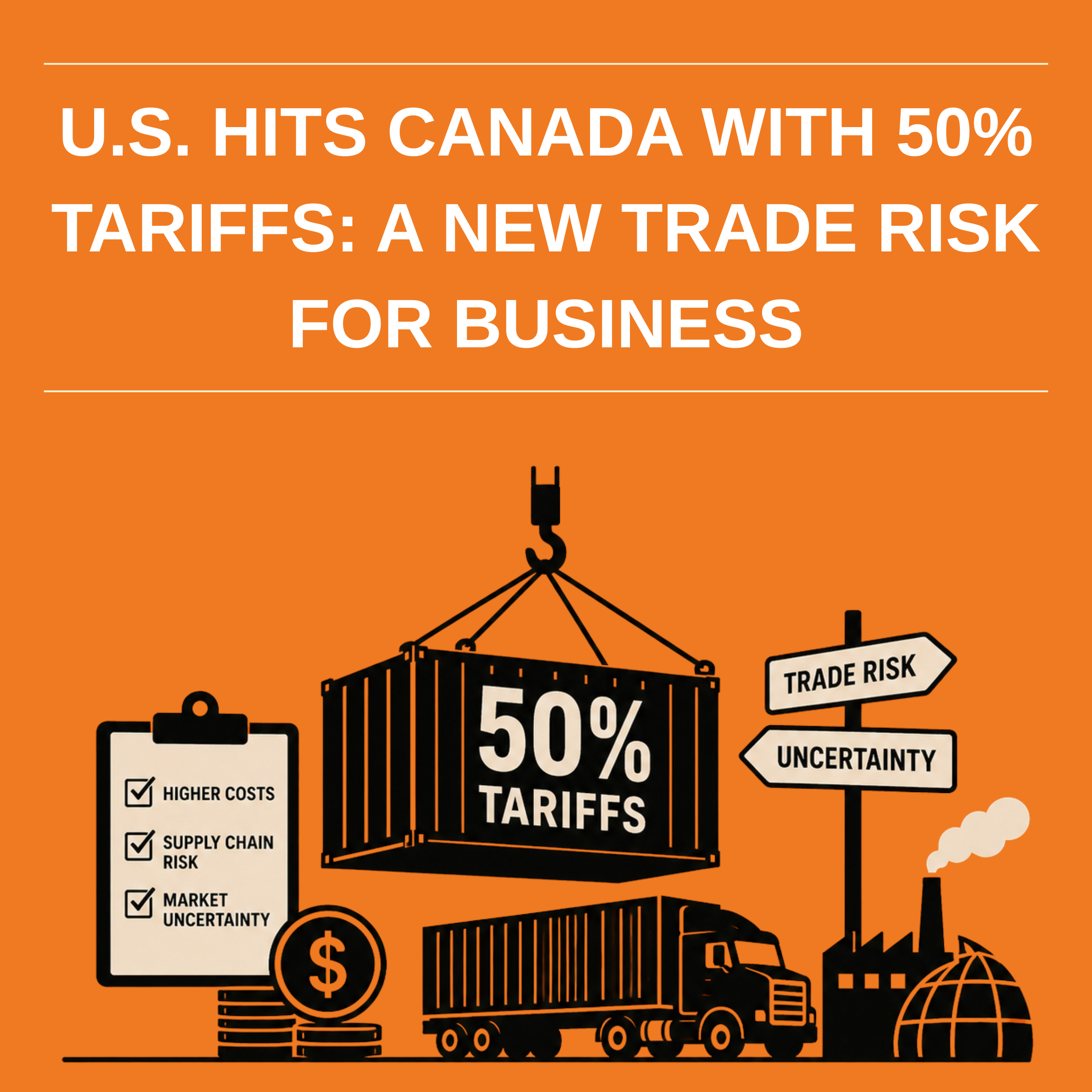
U.S. Hits Canada with 50% Tariffs: A New Trade Risk for Business

Safeguard protection is granted whenever an industry is suffering from serious financial injury, caused by an increase in imports, which was because of unforeseen developments stemming out of the 1994 GATT negotiations, to which South Africa was a signatory.

Safeguard measures are enacted to ensure enough breathing room for the domestic manufacturing industry in distress to adjust and become more competitive, usually within a period of 3-6 years.

For this remedial protection to be effective, these safeguard duties need to be monitored and enforced across the board. However, as part of the Safeguard Agreement, the Safeguard Regulations creates an “Exempted Countries” list. This exemption has shown to provide a safeguard duty-free roue for imports from countries which are developing in nature and from where imports did not originate prior to the imposition of the safeguard duties.

The” circumvention” becomes a problem when the bigger importers switch their sources from imports from the traditional exporting countries like China and Russia, to smaller, developing nations, like Taiwan and Indonesia, effectively bypassing the Safeguard duties in their entirety.
Other WTO member countries would normally act quickly against these changes by removing these “developing nations” quickly once its import volume exceeds the established threshold. No further investigation is required.

In South Africa, the remedial action linked to the imposition of safeguard measures are failing because the officer in charge of this administrative action, the Minister of Trade, Industry and Competition, Minister Dave Patel, fails in his duty to authorise these exempted country removals immediately, or at all in some cases. Imports that reduced because of the imposition of the safeguard duties, with a resultant uptick in local production, regained lost ground within a year of the duties being imposed, rendering the safeguard protection completely impotent.

Below is an import chart, providing insight on how imports of Hexagon Nuts, a product protected by safeguard duties have climbed to almost pre-safeguard levels, because of a lack of action by the government to curb imports from developing nations.

The United States is once again raising the stakes in global trade.

On 20 July 2026, President Trump announced 50% tariffs on a broad range of Canadian goods, effective 19 August 2026, under Section 338 of the U.S. Tariff Act of 1930.

The move is historic. Section 338 has not been used to impose tariffs since the 1930s. More importantly, the tariffs will apply to certain Canadian goods that would otherwise qualify for preferential treatment under the USMCA. For businesses, this is a clear reminder that trade agreements can no longer be treated as a guarantee of long-term market certainty.

The tariffs cover a wide range of industries, including alcoholic beverages; arts, crafts and antiques; chemicals; cement; dairy and animal products; essential oils; food, beverages and ingredients; furniture and lighting; garden plants, flowers and trees; glassware and jewellery; hides, leather and fur; machinery, equipment and electrical appliances; motor vehicles, boats and ships; oilseeds and vegetable products; optical instruments; plastics and rubber; textiles and apparel; tools and hardware; toys and recreation equipment; and wood products, including paper and printed materials.

Energy products, fertiliser, minerals and seafood are among the key categories excluded from the measures, while certain products already covered by Section 232 tariffs are also exempt.

Why this matters beyond Canada

This is not simply another dispute between Washington and Ottawa. It is part of a wider shift in the global trading system.

The U.S. is simultaneously pursuing trade investigations and potential tariff measures under Sections 301 and 232, while uncertainty around the future of the USMCA adds another layer of risk for North American supply chains.

For businesses, the implications are significant. Tariffs can quickly change the economics of sourcing, production and market access. They can redirect trade flows, create new competitive pressures and force companies to reconsider established supply chains.

What it means for South Africa

South African businesses should not assume that developments in North America are geographically distant and therefore irrelevant.

When major markets impose new tariffs, global trade flows move. Products that can no longer enter one market competitively may be redirected elsewhere, potentially increasing import pressure in markets such as South Africa. At the same time, new gaps in international markets can create opportunities for competitive exporters.

Companies should therefore be asking:

Where could trade diversion affect our market?
Could our products face increased import competition?
Are there new export opportunities emerging from changing global supply chains?
How exposed are our sourcing and customer markets to sudden tariff changes?


The lesson is clear: trade policy is now a business issue, not simply a government issue.
At The Commodity Trade Observer, we help businesses understand how changes in tariffs, trade remedies, market-access rules and global trade policy could affect their competitiveness. Our approach is to move beyond tracking developments and translate them into practical commercial implications.

Contact us to assess your exposure, identify emerging trade risks and opportunities, and develop a strategy to navigate an increasingly uncertain global trading environment.

- Ms. Lufuno Munzhelele

footer logo
We study the markets, trends, and emerging best practices, in various steel related industries and cover Trade Development and Operational Excellence to unlock the present and future value for our customers.
Give us a Call
Copyright © 2025. All Rights Reserved. Commodity Trade Observer. Designed and Developed by ThinkTank Creative. Privacy Policy.