Our products aims to
simplify & clarify
the complex trade dynamics that
affect a business’s risk
Publications

NEWS

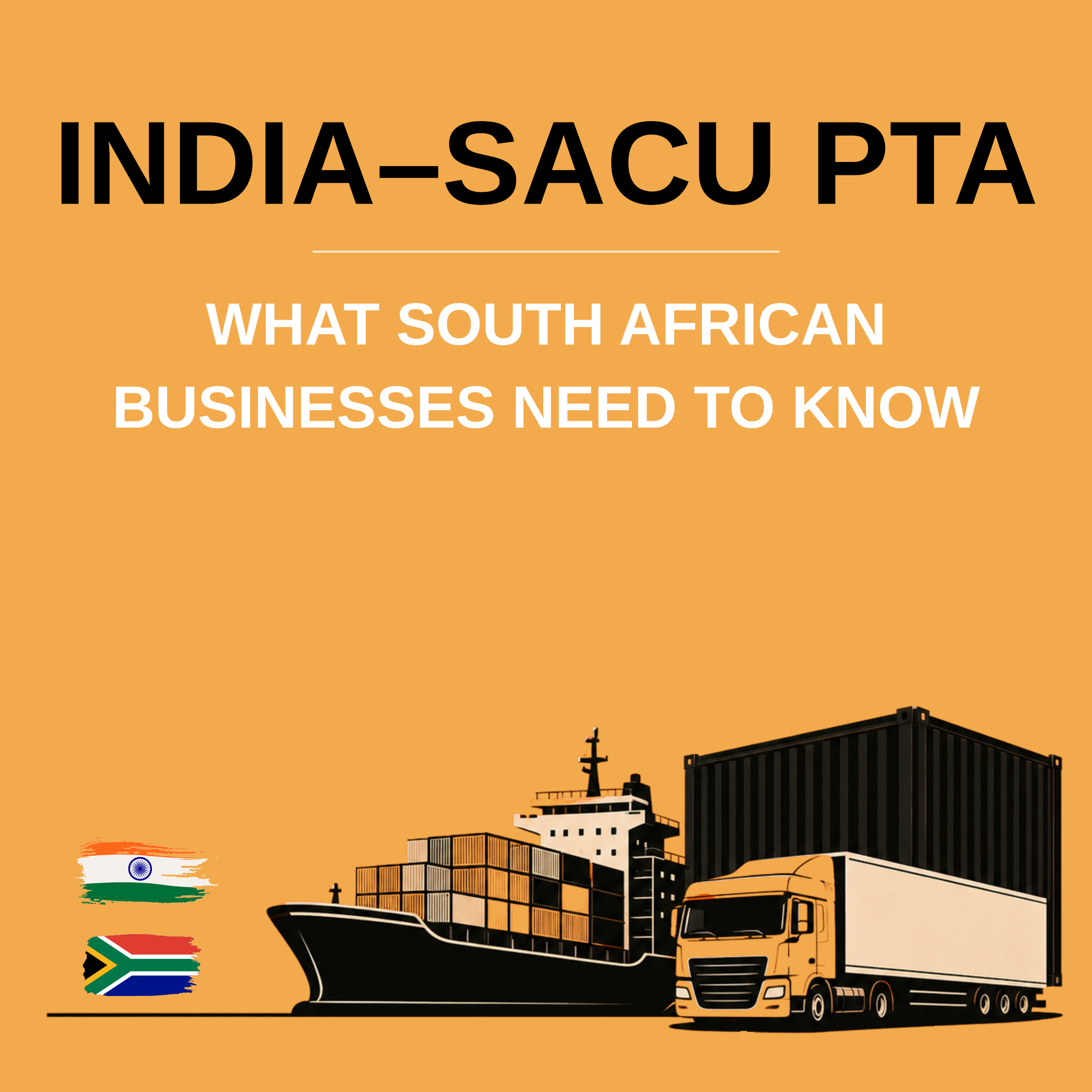
India–SACU PTA: What South African Businesses Need to Know

Safeguard protection is granted whenever an industry is suffering from serious financial injury, caused by an increase in imports, which was because of unforeseen developments stemming out of the 1994 GATT negotiations, to which South Africa was a signatory.

Safeguard measures are enacted to ensure enough breathing room for the domestic manufacturing industry in distress to adjust and become more competitive, usually within a period of 3-6 years.

For this remedial protection to be effective, these safeguard duties need to be monitored and enforced across the board. However, as part of the Safeguard Agreement, the Safeguard Regulations creates an “Exempted Countries” list. This exemption has shown to provide a safeguard duty-free roue for imports from countries which are developing in nature and from where imports did not originate prior to the imposition of the safeguard duties.

The” circumvention” becomes a problem when the bigger importers switch their sources from imports from the traditional exporting countries like China and Russia, to smaller, developing nations, like Taiwan and Indonesia, effectively bypassing the Safeguard duties in their entirety.
Other WTO member countries would normally act quickly against these changes by removing these “developing nations” quickly once its import volume exceeds the established threshold. No further investigation is required.

In South Africa, the remedial action linked to the imposition of safeguard measures are failing because the officer in charge of this administrative action, the Minister of Trade, Industry and Competition, Minister Dave Patel, fails in his duty to authorise these exempted country removals immediately, or at all in some cases. Imports that reduced because of the imposition of the safeguard duties, with a resultant uptick in local production, regained lost ground within a year of the duties being imposed, rendering the safeguard protection completely impotent.

Below is an import chart, providing insight on how imports of Hexagon Nuts, a product protected by safeguard duties have climbed to almost pre-safeguard levels, because of a lack of action by the government to curb imports from developing nations.

The revival of negotiations towards an India–SACU Preferential Trade Agreement (PTA) could reshape the competitive landscape for South African businesses.

On 12 August 2026, India and the Southern African Customs Union (SACU) signed the Terms of Reference for negotiations, formally reviving a process that stalled after five rounds between 2002 and 2010. The South African Department of Trade, Industry and Competition (the dtic) has confirmed the PTA as part of SACU’s ongoing trade negotiations with India.

For South African companies, this is more than a trade-policy development. Preferential tariff access can change the economics of importing, exporting and sourcing.

Why businesses should pay attention

India is a major manufacturing economy with strong capabilities across automotive, pharmaceuticals, machinery, chemicals, electrical equipment and engineering products.

If preferential tariffs are introduced, Indian suppliers could gain a cost advantage over suppliers currently entering South Africa under MFN tariffs. This could increase competitive pressure on domestic manufacturers.

At the same time, South African exporters could gain improved access to the Indian market.

The commercial impact will therefore depend on which products are covered, the tariff reductions negotiated, the implementation timetable and the rules of origin.

Where the opportunities and risks may emerge

The PTA could create opportunities for South African businesses in:

• minerals and beneficiated products;
• chemicals;
• metals and engineering products;
• automotive components;
• agricultural and processed products; and
• selected manufactured goods.

Potential risks are concentrated in sectors where Indian manufacturers already have significant scale and cost competitiveness, including automotive, pharmaceuticals, machinery, electrical equipment and selected manufactured products.

For steel and downstream manufacturing, the implications deserve particular attention. Increased access for Indian manufactured goods could affect import competition, while improved Indian market access could create opportunities for South African steel, metals and engineering exports.

The detail will matter.

The headline agreement will receive the attention. The tariff schedule will determine the commercial impact.

Companies should be monitoring:

- Tariff concessions – Which HS codes will receive preferential treatment and by how much?
- Rules of origin – What level of local content will be required to qualify?
- Phase-down periods – How quickly will tariffs be reduced?
- Exclusions and sensitive products – Which products may require protection or extended adjustment periods?
- Safeguards – What mechanisms will be available if imports increase sharply?
-Market access in India – Will South African exporters receive commercially meaningful access in sectors where they can compete?

What companies should do now

Businesses should not wait until the agreement is concluded to assess the impact.

A product-level India–SACU exposure assessment can identify:

• products vulnerable to increased Indian competition;
• potential export opportunities in India;
• tariff advantages that could arise under different scenarios;
• sensitive tariff lines requiring industry engagement;
• potential implications for sourcing and supply chains; and
• opportunities for investment and value-chain partnerships.

This analysis can also provide the evidence needed to support engagement with government and industry bodies during the negotiating process.

Our advisory support

CTO assists businesses in translating trade-policy developments into commercial strategy.

We can support companies with:

• India–SACU PTA impact assessments;
• HS-code and tariff analysis;
• import competition and market-share analysis;
• export opportunity assessments;
• tariff and rules-of-origin analysis;
• identification of sensitive products;
• trade-policy and government engagement; and
• strategic advice on tariff negotiations and market access.

Is your business exposed?
If your company imports from India, competes with Indian products in the South African market, or sees India as a potential export market, now is the time to assess the implications.
Contact CTO for a confidential discussion on how the India–SACU PTA could affect your products, costs, competitiveness and market-access opportunities.

- Ms Lufuno Munzhelele

footer logo
We study the markets, trends, and emerging best practices, in various steel related industries and cover Trade Development and Operational Excellence to unlock the present and future value for our customers.
Give us a Call
Copyright © 2025. All Rights Reserved. Commodity Trade Observer. Designed and Developed by ThinkTank Creative. Privacy Policy.