Our products aims to
simplify & clarify
the complex trade dynamics that
affect a business’s risk
Publications

NEWS

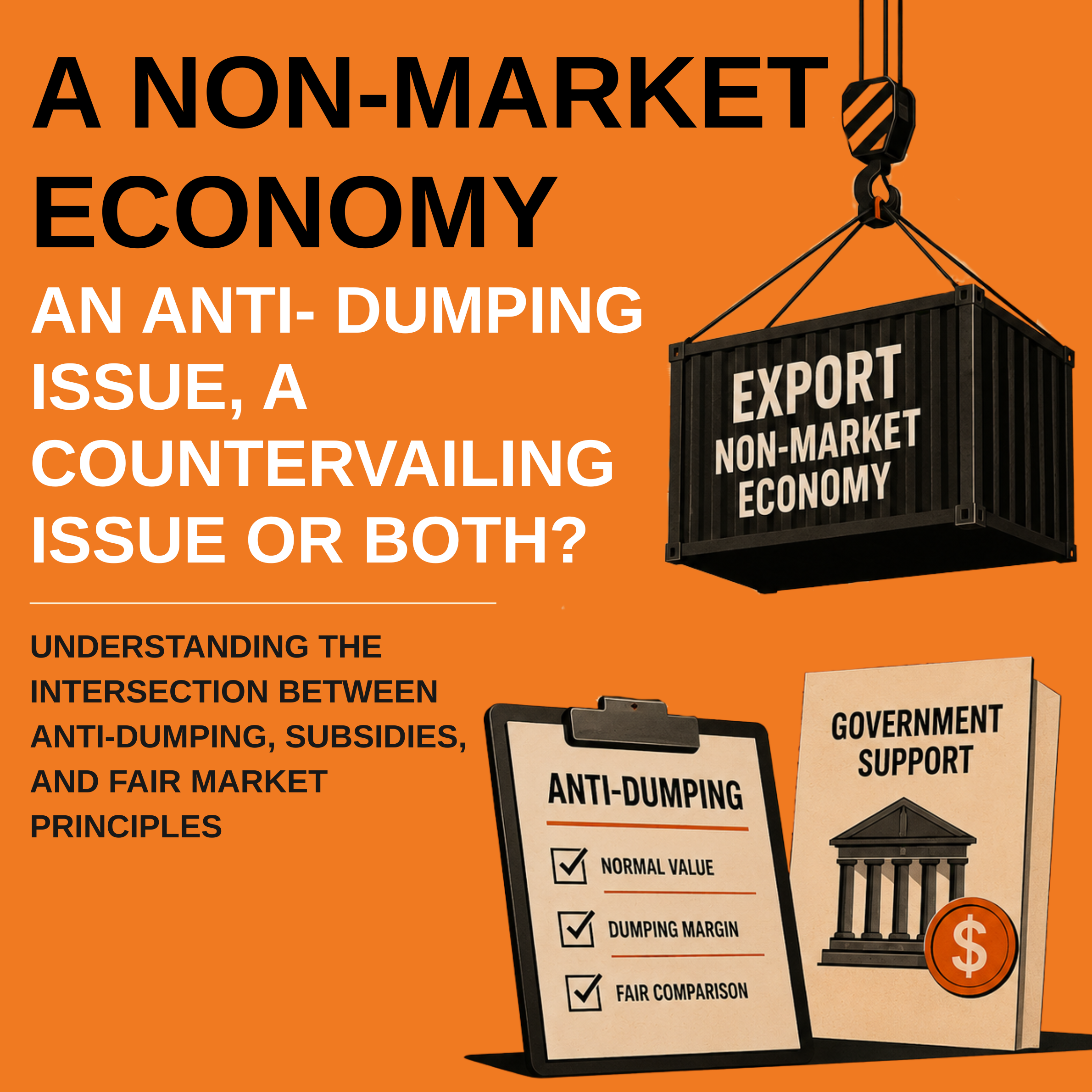
A Non-Market Economy: An anti- dumping issue, a countervailing issue or both?

Safeguard protection is granted whenever an industry is suffering from serious financial injury, caused by an increase in imports, which was because of unforeseen developments stemming out of the 1994 GATT negotiations, to which South Africa was a signatory.

Safeguard measures are enacted to ensure enough breathing room for the domestic manufacturing industry in distress to adjust and become more competitive, usually within a period of 3-6 years.

For this remedial protection to be effective, these safeguard duties need to be monitored and enforced across the board. However, as part of the Safeguard Agreement, the Safeguard Regulations creates an “Exempted Countries” list. This exemption has shown to provide a safeguard duty-free roue for imports from countries which are developing in nature and from where imports did not originate prior to the imposition of the safeguard duties.

The” circumvention” becomes a problem when the bigger importers switch their sources from imports from the traditional exporting countries like China and Russia, to smaller, developing nations, like Taiwan and Indonesia, effectively bypassing the Safeguard duties in their entirety.
Other WTO member countries would normally act quickly against these changes by removing these “developing nations” quickly once its import volume exceeds the established threshold. No further investigation is required.

In South Africa, the remedial action linked to the imposition of safeguard measures are failing because the officer in charge of this administrative action, the Minister of Trade, Industry and Competition, Minister Dave Patel, fails in his duty to authorise these exempted country removals immediately, or at all in some cases. Imports that reduced because of the imposition of the safeguard duties, with a resultant uptick in local production, regained lost ground within a year of the duties being imposed, rendering the safeguard protection completely impotent.

Below is an import chart, providing insight on how imports of Hexagon Nuts, a product protected by safeguard duties have climbed to almost pre-safeguard levels, because of a lack of action by the government to curb imports from developing nations.

Ordinarily, the normal value in anti- dumping investigations constitutes the domestic selling price of the subject product in the exporting country. However, both the WTO Anti- Dumping Agreement (ADA) and the South African Anti-Dumping Regulations set out an exception to this rule. Article 2.2 of the ADA provides that when there are no sales of the like product in the ordinary course of trade in the domestic market of the exporting country or when, because of a particular market situation or the low volume of the sales in the domestic market, do not permit a proper comparison, the margin of dumping shall be determined by comparison with a comparable price of the like product when exported to an appropriate third country, provided that the price is representative or with the cost of production in the country of origin plus a reasonable amount for administrative, selling and general costs and profits.

 The corresponding provision to Article 2.2 ADA is outlined in both Section 32(4) of the International Trade Administration Act and Regulation 8.2 of the ADR, which permits the Commission to establish a normal value on the basis of a third-country or surrogate-country approach.

The pertinent issue is the probative value of evidence where there are concerns that the exporter, in the context of an anti-dumping investigation, is a beneficiary of government support measures in the form of subsidies. The International Trade Administration Commission (ITAC), or the Commission, for example, in ITAC Report 767, the Applicant raised concerns that the exporter was a recipient of a subsidy. The Commission dismissed the concern by stating, “the Applicant sought to introduce subsidy-related considerations into an anti- dumping investigation”. The Commission further advised the Applicant to pursue a countervailing application to pursue the claim. (Page 49 of the Report)

Although the Commission did not base the normal on the domestic sales from the exporting country for other reasons, the Commission's conclusion that subsidy-related concerns cannot be raised in anti-dumping investigations is legally flawed. This is because evidence of government support measures is relevant in answering three cardinal questions in an anti-dumping investigation outlined below.

A. whether the exporters’ domestic sales were made in the ordinary course of trade (section 32(2)(b) of the ITA Act; ADR 8.2);

B. whether a particular market situation exists by reason of which those sales do not permit a proper comparison (Article 2.2 of the Anti-Dumping Agreement); and

C. whether the normal value is, as a result of government intervention in the exporting country, not determined according to fair market principles (section 32(4) of the ITA Act).

In conclusion, while this finding did not ultimately determine the outcome in Final Determination No. 767, its broader implications should not be understated. If left unaddressed, it may unduly constrain the Commission’s consideration of government support in future anti-dumping investigations, notwithstanding its potential relevance to the assessment of ordinary course of trade, market conditions, and fair market principles. This could have systemic consequences where an Applicant adduces prima facie evidence that exporters benefit from material government support measures

-Annabel Nanjira

footer logo
We study the markets, trends, and emerging best practices, in various steel related industries and cover Trade Development and Operational Excellence to unlock the present and future value for our customers.
Give us a Call
Copyright © 2025. All Rights Reserved. Commodity Trade Observer. Designed and Developed by ThinkTank Creative. Privacy Policy.