Our products aims to
simplify & clarify
the complex trade dynamics that
affect a business’s risk
Publications

NEWS

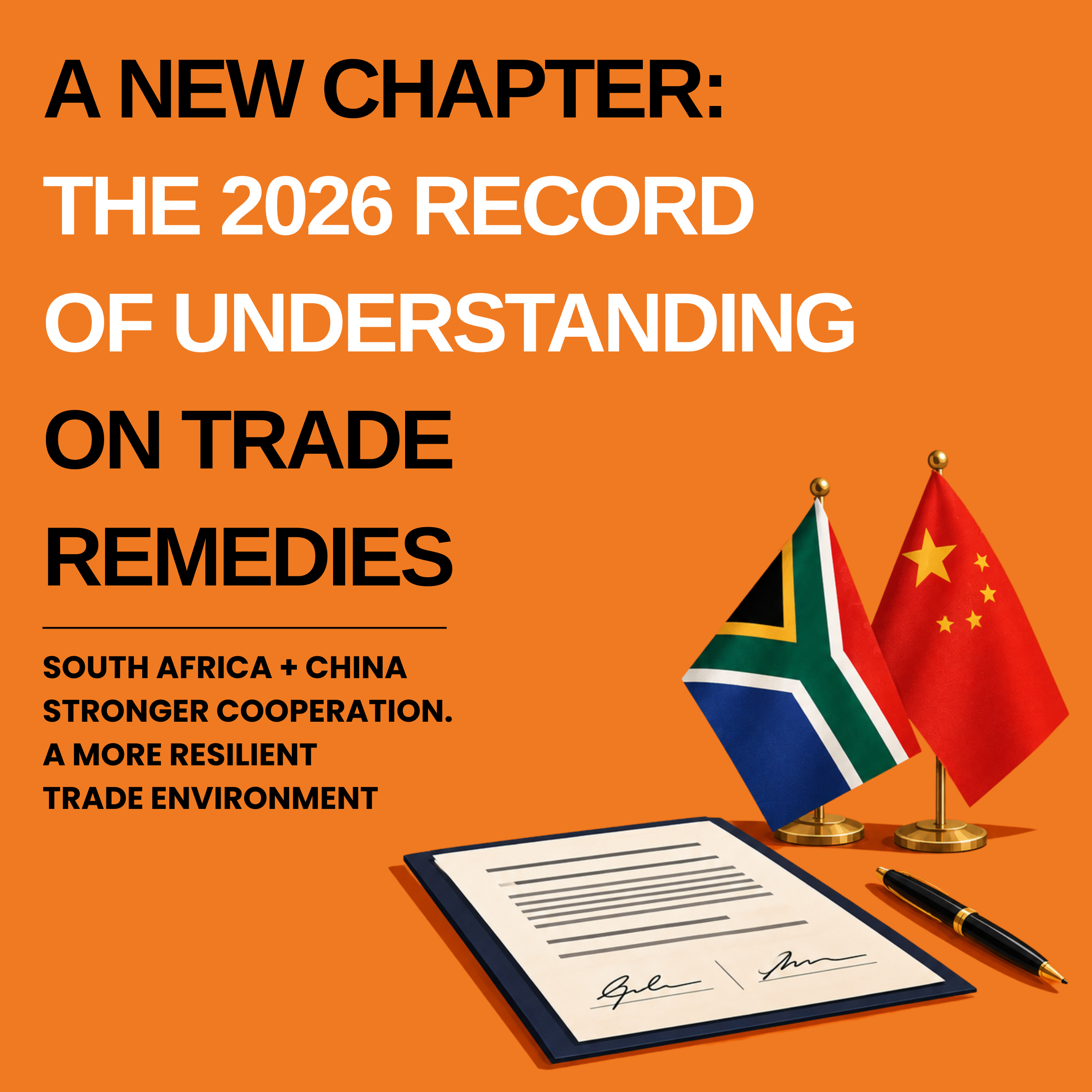
A New Chapter: The 2026 Record of Understanding on Trade Remedies

Safeguard protection is granted whenever an industry is suffering from serious financial injury, caused by an increase in imports, which was because of unforeseen developments stemming out of the 1994 GATT negotiations, to which South Africa was a signatory.

Safeguard measures are enacted to ensure enough breathing room for the domestic manufacturing industry in distress to adjust and become more competitive, usually within a period of 3-6 years.

For this remedial protection to be effective, these safeguard duties need to be monitored and enforced across the board. However, as part of the Safeguard Agreement, the Safeguard Regulations creates an “Exempted Countries” list. This exemption has shown to provide a safeguard duty-free roue for imports from countries which are developing in nature and from where imports did not originate prior to the imposition of the safeguard duties.

The” circumvention” becomes a problem when the bigger importers switch their sources from imports from the traditional exporting countries like China and Russia, to smaller, developing nations, like Taiwan and Indonesia, effectively bypassing the Safeguard duties in their entirety.
Other WTO member countries would normally act quickly against these changes by removing these “developing nations” quickly once its import volume exceeds the established threshold. No further investigation is required.

In South Africa, the remedial action linked to the imposition of safeguard measures are failing because the officer in charge of this administrative action, the Minister of Trade, Industry and Competition, Minister Dave Patel, fails in his duty to authorise these exempted country removals immediately, or at all in some cases. Imports that reduced because of the imposition of the safeguard duties, with a resultant uptick in local production, regained lost ground within a year of the duties being imposed, rendering the safeguard protection completely impotent.

Below is an import chart, providing insight on how imports of Hexagon Nuts, a product protected by safeguard duties have climbed to almost pre-safeguard levels, because of a lack of action by the government to curb imports from developing nations.

Two decades on, the trade remedies cooperation envisioned in Article 3 of the 2006 MoU has been formally refreshed. On 26 August 2026, in Beijing, South Africa's International Trade Administration Commission (ITAC) and China's Trade Remedy and Investigation Bureau (TRB), part of the Ministry of Commerce, signed an updated Record of Understanding (RoU) on Cooperation in Trade Remedies Investigations, signed by Ayabonga Cawe (ITAC Chief Commissioner) and Peng Tao (TRB Director-General).

This new RoU explicitly recalls both the 2004(/2006) MoU and an earlier 2006 RoU between ITAC and China's then-named Bureau of Fair Trade for Imports & Exports (BOFT), the institutional predecessor to TRB. Rather than replacing the original trade framework, it recalibrates and modernizes the trade-remedies cooperation piece for a very different global trade environment, one now shaped by the WTO's Anti-Dumping Agreement, the Agreement on Subsidies and Countervailing Measures, the Agreement on Safeguards, and newer regional arrangements like SADC, AfCFTA, and RCEP.

What's new in the 2026 RoU:

- Information sharing on pricing data. Where reliable pricing data can't be obtained directly from each other's markets, the authorities agree to rely on publicly available data from independent sources, trade databases, customs statistics, commodity indices, and to consult on how that data should be interpreted.

- Technical cooperation and capacity building. Joint seminars, expert exchanges, and training on injury analysis, causal link, price effects, and verification techniques.

- Notification obligations. Each party commits to notifying the other when it receives an application for a trade remedy investigation or an extension of measures, in line with WTO rules.

- Third-country and trans-shipment issues (Article 7). A notable new addition addresses the complexity of global value chains — including trans-shipment, minimal processing, and cross-border investment measures that could affect market conditions in third countries. Cooperation here is explicitly voluntary, non-binding, and can't create new rights, obligations, or prejudice future investigations.

- Procedural independence safeguards. The RoU is careful to state that any political or diplomatic engagement on trade remedies must fully respect the procedural independence of the investigating authority and preserve domestic industries' rights to pursue remedies against unfair trade.

- Special and differential treatment. Both sides commit to respecting WTO provisions on special and differential treatment for developing-country members.

- Confidentiality and data protection. Information exchanged is to be kept confidential, with any personal data handled in line with South Africa's Protection of Personal Information Act (POPIA).

- Governance. A Working Group will meet every two years, alternating between China and South Africa, with the option of ad hoc meetings. The RoU takes effect on signature and can be terminated with three months' written notice through diplomatic channels.

Importantly, Article 9 states plainly that this RoU is not legally binding and creates no rights or obligations under international or domestic law — it is, in the document's own words, "a statement of mutual intent and cooperation." That framing is consistent with the 2006 MoU's broader approach: these instruments set expectations and cooperative machinery rather than imposing enforceable trade rules, leaving actual trade remedy decisions to each country's own legal processes under WTO law.


footer logo
We study the markets, trends, and emerging best practices, in various steel related industries and cover Trade Development and Operational Excellence to unlock the present and future value for our customers.
Give us a Call
Copyright © 2025. All Rights Reserved. Commodity Trade Observer. Designed and Developed by ThinkTank Creative. Privacy Policy.